Semolina for Pizza: Why Use It & How Much?
Share
Learn how to use semolina for pizza, whether semolina is better than flour for launching, how much to use and how to stop it burning on the stone.
Semolina is one of those pizza ingredients that can make launching easier when you use a little — and make a bitter, burnt mess when you use too much.
Quick answer: use a very light dusting of fine semolina or semola on the peel to reduce sticking and help the pizza slide. You do not need a thick layer. At very high pizza-oven temperatures, excess semolina burns quickly, so less is better.
What is semolina?
Semolina is made from durum wheat. It is usually more golden and granular than ordinary wheat flour. In Italian shops you may also see semola rimacinata, a finer, twice-milled durum wheat flour.
The texture is useful for pizza because the small grains can act like tiny ball bearings between the dough and peel.
Why use semolina for pizza?
The main reason is launching. Fresh pizza dough can stick to a wooden or metal peel, especially if it sits there while you slowly add toppings. A small amount of semolina helps separate the dough from the peel and reduces friction.
It can also add a slight crispness to the underside, but it should be treated as a handling aid rather than a heavy coating.
Semolina vs 00 flour for pizza
They do different jobs. Tipo 00 flour is commonly used as the main flour in Neapolitan-style dough because of the way it mills and handles. Semolina is often used on the peel or work surface to make stretching and launching easier.
You can dust with 00 flour alone, semolina alone or a light blend of the two. The best choice depends on oven temperature and how confidently you launch.
How much semolina should you use?
As little as you can get away with. Sprinkle a thin, even layer over the peel, then shake off obvious excess before building or launching the pizza.
If you can see a deep bed of grains underneath the pizza, you have probably used too much. Loose semolina left on a hot stone will scorch, particularly during repeated high-temperature bakes.
Does semolina burn in a pizza oven?
Yes. All loose flour can burn on a very hot cooking floor, and semolina is no exception. At Neapolitan-style temperatures, burnt dusting flour can leave black grit underneath the pizza and introduce bitterness.
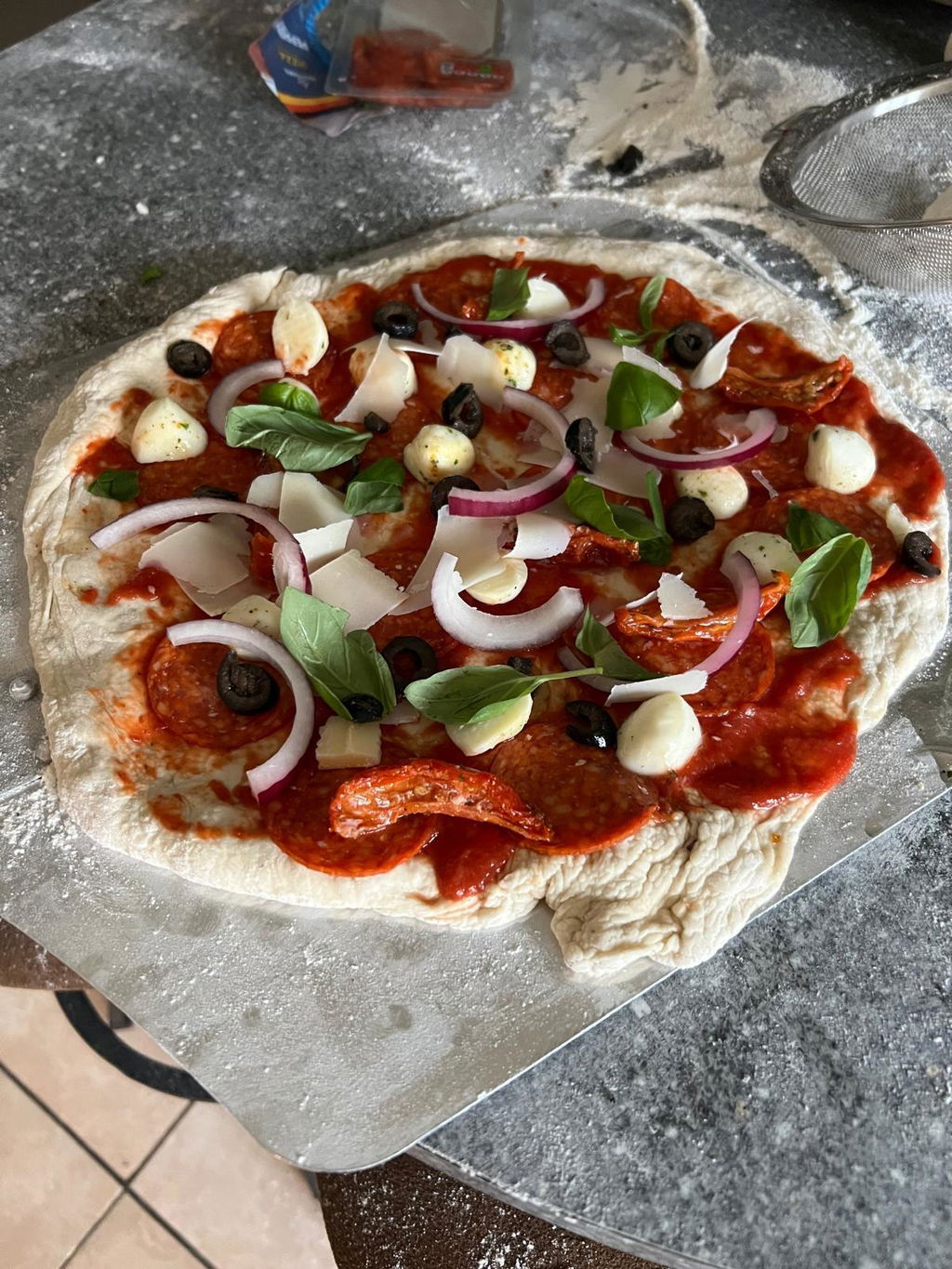
That is why fast workflow matters. Stretch the dough, dust the peel lightly, top efficiently, give the peel a small shake to make sure the pizza is free, then launch.
Fine or coarse semolina for pizza?
A finer semolina or semola rimacinata is generally easier to use for pizza because it gives you the anti-stick benefit without leaving large hard grains on the base.
Very coarse semolina can feel gritty and may be more noticeable after baking. If your local shop only sells a coarse product, use it particularly sparingly.
Can you put semolina in pizza dough?
Yes, some pizza and bread styles use durum wheat or semolina as part of the dough formula. But that is a different use from dusting a peel.
For a Neapolitan-style dough built around Tipo 00 flour, you do not need to add semolina to the dough simply because you use it for launching. Our Dough Dorks pizza dough balls are already mixed, fermented and portioned; a little semolina is simply there to make handling easier.
Semolina on a wooden peel
A wooden launching peel naturally helps because raw dough tends to stick less readily to wood than to bare metal. Add a very light semolina dusting, keep the peel dry and do not leave the topped pizza sitting on it.
Before you approach the oven, give the peel a short forward-and-back shake. If the pizza moves freely, it is ready to launch. If one edge sticks, lift that edge gently and add a pinch of dusting flour underneath rather than covering the whole peel again.
Semolina on a metal peel
Metal launching peels can work brilliantly but raw dough can grab the surface more easily, particularly if condensation forms under a cold dough ball.
Work quickly and use a minimal dusting. Many pizza makers prefer wood for launching and metal for turning, but either can work with good technique.
What if the pizza still sticks?
- Make sure the dough is not excessively wet on the outside.
- Do not sauce the pizza while it is sitting on the peel for several minutes.
- Keep sauce away from the very edge where it can leak underneath.
- Do not overload the centre with heavy toppings.
- Check the pizza still slides before carrying it to the oven.
- Use a light dusting rather than trying to solve sticking with a mountain of flour.
Semolina and pizza steels
A pizza steel transfers heat very aggressively, so excess dusting flour can colour quickly. The same rule applies: minimal semolina, a confident launch and no piles of loose flour left behind.
The simple Dough Dorks method
- Bring the dough to the correct temperature and stretch it by hand.
- Dust the peel lightly with fine semolina or a semolina/flour blend.
- Move the stretched base onto the peel.
- Add sauce, cheese and toppings quickly.
- Shake the peel to confirm the pizza moves.
- Launch immediately.
Semolina is not a secret ingredient that fixes bad technique. It is a small handling aid that makes good technique more forgiving.
Start with properly fermented dough and the rest gets much easier. Shop 48-hour fermented pizza dough balls →