260g Default and Rule of 22: Pizza Dough Ball Weights by Style
Start with a 260g default for 12 inch pies, use Rule of 22 and thickness factor math to match dough ball weights to crust style and hydration.
For a 10-inch pizza, use a typical dough weight appropriate for that size, as recommended by FLAME PIZZA&PASTA. A 12-inch pizza generally needs a moderate amount of dough, with larger pizzas requiring proportionally more dough according to common style ranges. The fastest way to figure out any size in between: multiply the diameter in inches by 22, so a 12-inch pizza gets 264 grams. Style shifts the number up or down, and hydration or bench handling can swing your final ball by 5 to 10%.
TL;DR:
- Using 260 grams as a default for 12-inch pizzas works well for most styles, but adjust based on desired crust thickness or toppings.
- Hydration levels influence dough weight loss and handling, with higher hydration requiring more care and possibly more dough for the same size.
- Pan and Detroit-style pizzas typically need 400 grams or more for 12-inch sizes due to the thicker, oil-finished crust.
- The Rule of 22 provides a quick estimate, multiplying the pizza diameter by 22 grams, but the thickness factor yields more precise results for consistent crusts.
- Pre-portioned dough balls for fermenting or immediate use eliminate guesswork and improve consistency during pizza preparation.
Table of Contents
- Pizza Dough Ball Weight Chart for Every Size and Style
- How Do You Calculate Pizza Dough Ball Weight?
- Why Does Crust Style Change the Target Weight?
- How Should Hydration and Handling Change Your Final Weight?
- How Do You Scale Dough for a Party of Pizzas?
- What Bench Habits Actually Improve Weight Accuracy?
- Why Trust These Numbers?
- A Practical Default Worth Starting With
- Get Dough Balls Already Weighed for Your Pizza Size
- Sources
- FAQ
Pizza Dough Ball Weight Chart for Every Size and Style
Dough weight isn’t one number. It shifts with crust style, and a Neapolitan and a Detroit pan pizza at the same diameter can differ by more than 200 grams.
| Diameter | Thin/Crispy (55–60% hydration) | Neapolitan (60–65% hydration) | New York (60% hydration) | Pan/Detroit (65–70% hydration) |
|---|---|---|---|---|
| 10" | 200 g | 200–220 g | 210 g | 280–320 g |
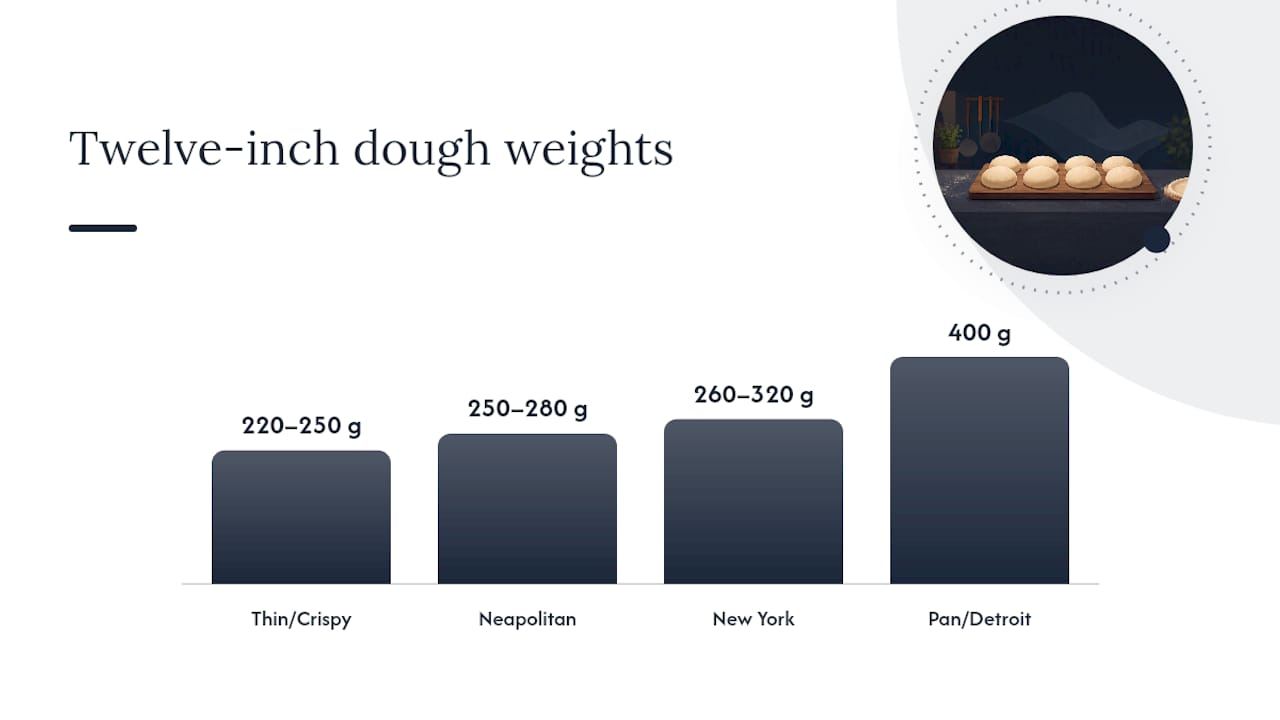
| 12" | 220–250 g | 250–280 g | 260–320 g | 400 g |
| 14" | 300 g | 330 g | 350 g | 550 g |
| 16" | 400 g | 430 g | 460 g | 720 g |
These ranges track closely with what Pizza Today’s industry guidance reports for AVPN-style Neapolitan targets, and with the broader style tables published by Miss Vickie’s dough calculator.
Pick the lower end of a range when you want a thinner, crackly bite or you’re working with a smaller pizza steel. Pick the higher end when you’re loading extra toppings, want a puffier cornicione, or you’re baking on a large deck oven that can support more mass without turning the base soggy.
How Do You Calculate Pizza Dough Ball Weight?
Two methods cover almost every situation: the quick Rule of 22, and the more precise thickness-factor (TF) method.
- Rule of 22. Multiply your pizza’s diameter in inches by 22 to get grams. A 12-inch pizza: 12 × 22 = 264 grams. A 16-inch: 16 × 22 = 352 grams. This shortcut comes from Baking Steel’s Rule of 22 and works well for home ovens and steels, landing close to a mid-range Neapolitan or New York crust.
- Thickness factor. Find the pizza’s area with πr², then multiply by a style-specific grams-per-square-inch value. A 12-inch pizza has a radius of 6 inches, so its area is roughly 113 square inches (π × 6²). A New York-style pizza at a TF of about 2.4 g/in² comes to roughly 270 grams. A Neapolitan at a lighter TF near 2.2 g/in² lands closer to 250 grams. This is the logic behind tools like the pizza dough ball weight calculator.
Reach for TF when you’re chasing a specific crust profile, dialing in a recipe across multiple diameters, or trying to match a particular pizzeria’s texture rather than a rough home-oven estimate.
Why Does Crust Style Change the Target Weight?
Diameter tells you the size of the circle, not how much dough belongs inside it. Style determines the rest.
- Neapolitan stays lean, typically 250 to 280 grams for a 12-inch pizza, because AVPN tradition calls for no oil in the dough and a thin, soft base that puffs fast in an 800°F-plus oven, as AVPN’s own guidelines lay out.
- New York style runs a bit heavier, around 260 to 320 grams at 12 inches, since it needs enough structure to hold up folded in hand and usually includes a small amount of oil for a chewier bite.
- Thin and crispy styles trim down to 220 to 250 grams at 12 inches, prioritizing crunch over any real rim.
- Pan and Detroit styles jump dramatically, often 400 grams or more for a 12-inch pan, because the dough proofs directly in an oiled pan and needs enough mass to fill the corners and rise thick.
A generous cornicione, that puffed outer rim on a Neapolitan pizza, also eats up dough that would otherwise go under the toppings. If you’re baking on a home steel rather than a commercial deck, lean toward the lower end of any range, since Baking Steel notes that overloading a smaller surface makes the base soggy instead of crisp.
How Should Hydration and Handling Change Your Final Weight?
Hydration doesn’t just change texture. It changes how much usable dough actually survives the trip from mixing bowl to pizza.
- 55 to 60% hydration handles easily, tears rarely, and loses very little to trimming, so a smaller reserve is fine.
- 60 to 65% hydration gives better oven spring and a more open crumb but sticks more during shaping.
- 65 to 70% hydration, common for pan and Detroit styles, is slack and hard to portion cleanly, which means more loss on the bench.
Miss Vickie’s dough calculator recommends staying near the higher end of that range for high-hydration doughs and for less experienced hands.
Quick math: for four 12-inch pizzas at 260 grams each, your base total is 1,040 grams.
How Do You Scale Dough for a Party of Pizzas?
The formula is simple: total dough needed = ball weight × number of pizzas × (1 + reserve percentage).
- Four 12-inch pizzas at 260 grams, with a 5% reserve: 260 × 4 × 1.05 = 1,092 grams total.
- Eight 12-inch pizzas at 260 grams, same 5% reserve: 260 × 8 × 1.05 = 2,184 grams total.
- Twelve 12-inch pizzas at 260 grams, bumped to an 8% reserve for a bigger batch: 260 × 12 × 1.08 = 3,370 grams total.
For cold ferment, portion the dough into balls before it goes into the fridge, not after, so each ball proofs evenly over 24 to 72 hours. Same-day dough can be scaled and balled right after the bulk rise, but give it at least two hours at room temperature before shaping. Store portioned balls in individual containers or lightly oiled proofing pots. That keeps them from fusing together and makes it easy to grab exactly the number you need, a step Dough Dorks’ proofing guide covers in more detail. If you’re holding dough longer than a couple of hours at room temperature, the FDA’s HACCP guidance is a useful reference for safe holding temperatures.
What Bench Habits Actually Improve Weight Accuracy?
Round each ball to the nearest 5 grams rather than chasing exact-to-the-gram precision. Flour absorbs moisture differently by batch, so obsessing over single grams wastes time without improving results.
- Weigh dough on a digital scale, not measuring cups, since flour volume varies by up to 20% depending on how it’s packed.
- Rest shaped balls in individual proofing pots for at least 30 to 45 minutes before you try to open them, so the gluten relaxes and you don’t fight the dough into a thin spot.
- Shape from the center outward with your fingertips, leaving the outer inch untouched, to protect the cornicione instead of stretching it flat.
- Make one test ball at your target weight and bake it before committing a full batch, especially if you’ve changed hydration or flour type.
Pro Tip: Keep one extra ball, weighed the same as the rest, as a dedicated test bake. It tells you whether your oven, steel, or stone needs a slightly heavier or lighter ball before you commit the whole batch.
Why Trust These Numbers?
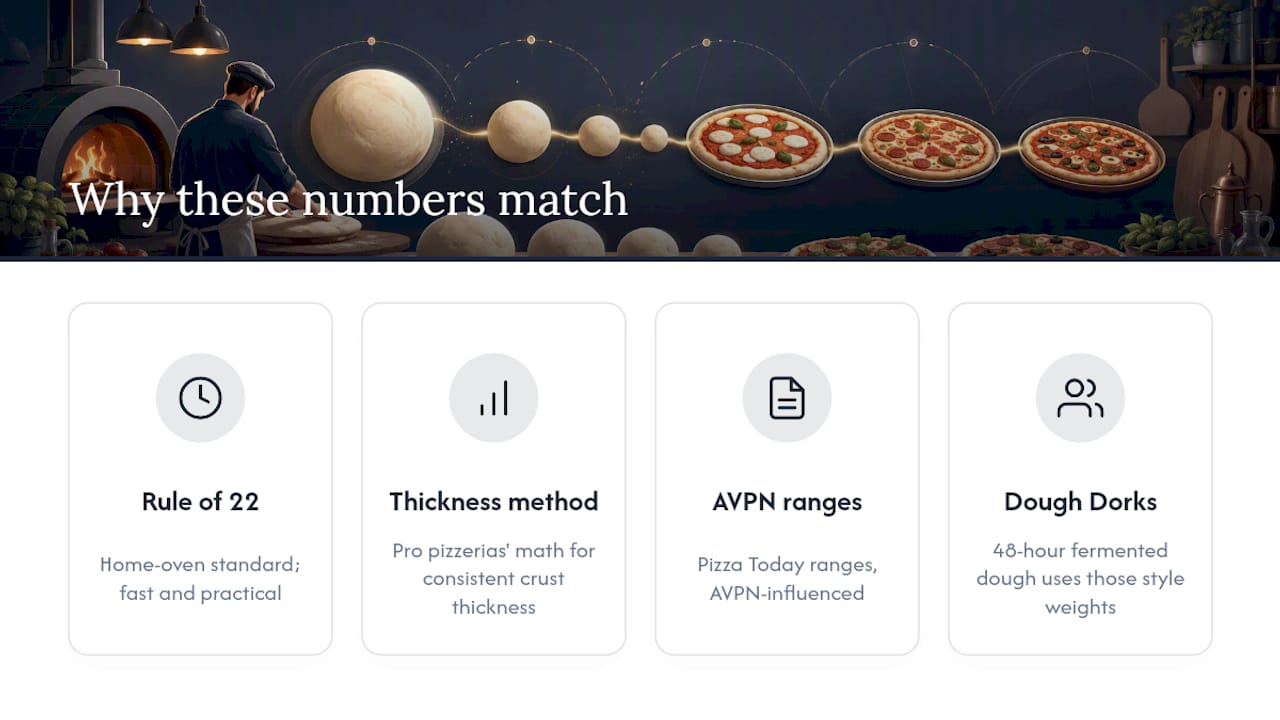
These ranges aren’t guesswork. They come from a mix of long-standing industry shorthand and the same math professional pizzerias used to control crust thickness at scale.
The Rule of 22 has been a home-oven standard for years because it’s fast and close enough for most bakes. The thickness-factor method used by tools like the pizza dough ball weight calculator is what pizzerias rely on when they need the same crust thickness across dozens of pies a night. Both land in roughly the same neighborhood as the AVPN-influenced ranges Pizza Today reports, which is a good sign that none of these methods are pulling numbers out of thin air.
Dough Dorks builds its 48-hour fermented dough balls around these same style-specific weights, so the 12-inch Neapolitan dough you order lands right where the math above says it should. If you want to see the reasoning behind a specific size, the 12-inch dough weight breakdown walks through the same logic in more depth.
A Practical Default Worth Starting With
Most of the confusion around dough weight comes from people trying to find one perfect number instead of a workable starting point. Skip that search. Use the Rule of 22, or just go with 260 grams for any 12-inch pizza, and adjust from there once you’ve tasted the result.
Bake one test ball before you commit a whole batch to a new weight. It costs you one pizza and saves you a ruined party spread. Pre-portioned options remove the guesswork entirely if you’d rather spend your Saturday cooking instead of calculating.
— Michael
Get Dough Balls Already Weighed for Your Pizza Size
Pre-portioned 48-hour fermented dough balls arrive individually proofed and already portioned to the sizes covered in this guide, made with Italian 00 flour, fresh yeast, and extra virgin olive oil.

If you’re after a classic Neapolitan pull, the 48-hour Neapolitan dough by weight matches the lighter, leaner range this guide recommends for a proper cornicione. Want something with more chew for a New York-style fold, or extra structure for a heavier topping load? The sourdough pizza dough balls and the full dough ball collection cover both ends of that spectrum, each shipped in a free recyclable proofing pot with UK-wide insulated delivery.
Skip the scale entirely for pizza night. Browse the full range of dough balls, pre-cooked bases, and ready-made pizzas and get a weight-matched dough ball on your counter before the weekend.
Sources
FAQ
What Size Pizza Does a 250-Gram Dough Ball Make?
A 250-gram ball typically makes a 12-inch Neapolitan-style pizza with a thin base and a puffy rim. Using the Rule of 22, 250 grams sits just under the 264-gram target for a 12-inch pizza, so expect a slightly thinner crust than the average.
How Much Should a Pizza Dough Ball Weigh?
It depends on diameter and style, but 200 to 220 grams covers a 10-inch pizza, 250 to 280 grams covers a 12-inch Neapolitan, and 330 to 520 grams covers 14 to 16-inch pizzas. Pan and Detroit styles run considerably heavier at every size because the dough fills a deep, oiled pan.
How Much Does a 12-Inch Neapolitan Dough Ball Weigh?
A 12-inch Neapolitan dough ball generally weighs 250 to 280 grams, in line with the AVPN-influenced ranges Pizza Today reports. Dough Dorks’ own Neapolitan dough balls are portioned within this same range.
What Size Pizza Does a 20-Ounce Dough Ball Make?
A 20-ounce dough ball converts to about 567 grams, and this size is suitable for larger pizzas or smaller pan-style pizzas, depending on how thick you want the final crust to be.
Recommended
- How Much Dough for a 12-Inch Pizza?
- Neapolitan Pizza Dough Calculator Explained
- What Size Container Do I Need for a Pizza Dough Ball?
- Buying and Baking Ready-Made Neapolitan Pizza Dough Balls
READY-MADE • FROZEN • UK DELIVERY
Skip the mixing. Keep proper dough in your freezer.
48-hour fermented, individually proofed in their own pot and delivered frozen across the UK. Defrost, stretch, top and bake.
-
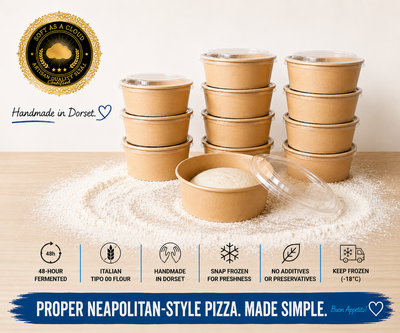 48-Hour Neapolitan-Style Pizza Dough Balls – Box of 12
£22.88
-
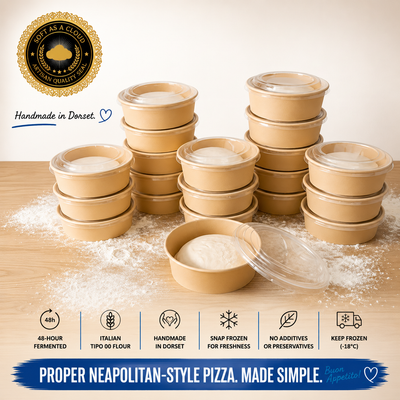 48-Hour Neapolitan-Style Pizza Dough Balls – Box of 20
£32.30
-
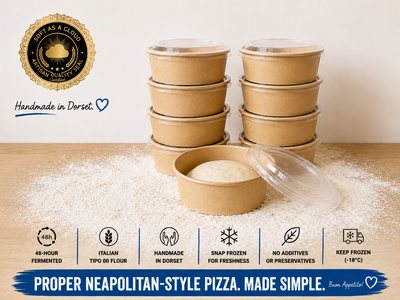 48-Hour Neapolitan-Style Pizza Dough Balls – Box of 8
£18
Handmade in Dorset • Free UK delivery over £50 • Free proofing pot with every dough ball