Neapolitan Salt Percentage: 2.5–3.0% and Exact Grams for Home Cooks
Use 2.5–3.0% salt by flour weight. Find exact grams for 500g and 1kg batches, two formulas you can copy, and when to cut salt for cold fermentation.
Use 2.5–3.0% salt by flour weight. Pick 2.5% for dough that will spend a day or two in the refrigerator, and 2.8–3.0% for traditional Neapolitan dough that ferments at room temperature before a fast, hot bake. Weigh it in grams rather than trusting a spoon, since salt volume varies wildly by crystal size.
TL;DR:
- Using 2.5 to 3.0% salt by flour weight is standard, with 2.5% being safer for longer refrigeration and 3.0% for faster, room-temperature doughs.
- Salt strengthens gluten and slows yeast activity, requiring higher percentages in Neapolitan dough to control fast fermentation and enhance flavor during quick bakes.
- Salt measurements should be precise with a scale, dissolved fully in water before mixing, and never contact yeast directly to avoid uneven fermentation.
- Cold fermentation in the fridge reduces the need for higher salt levels, as it naturally slows yeast activity, unlike room-temperature dough that requires more salt.
- Pre-measured, tested dough from suppliers or dough calculators can eliminate the need for manual salt percentage calculations and improve consistency.
Table of Contents
- How much salt in pizza dough per 500g and 1kg of flour?
- Why does salt percentage matter so much in Neapolitan dough?
- How do you calculate baker’s percentage for salt?
- Should you adjust salt for cold fermentation or room temperature?
- What are the most common salt mistakes in pizza dough?
- Two salt percentage formulas you can copy right now
- Getting the salt percentage right without doing the math yourself
- Skip the math with dough that’s already fermented right
- Sources
- FAQ
How much salt in pizza dough per 500g and 1kg of flour?
Once you know your target percentage, the gram math is simple: multiply your flour weight by the salt percentage. Here’s what that looks like at the three most common Neapolitan targets.
For 500g of flour:
- 2.5% salt = 12.5g
- 2.8% salt = 14g
- 3.0% salt = 15g
For 1,000g of flour:
- 2.5% salt = 25g
- 2.8% salt = 28g
- 3.0% salt = 30g
These numbers assume a hydration around 60–65%, with 62% being a common Neapolitan sweet spot. Hydration and salt percentage are both calculated against flour weight, so changing your water amount doesn’t change how much salt you need. Salt is scaled to flour, full stop.
For a quick workflow, start at 2.5% if you’re not sure which way to lean. It’s the safer default: forgiving on flavor, gentle on fermentation speed, and hard to mess up. Move up toward 3.0% only once you’ve got a specific reason, like a room-temperature rise that needs slowing down, or a very fast baking time where extra seasoning enhances flavor. If you’d rather skip the math altogether, Dough Dorks’ dough calculator converts any percentage to grams for whatever batch size you’re working with.
Why does salt percentage matter so much in Neapolitan dough?
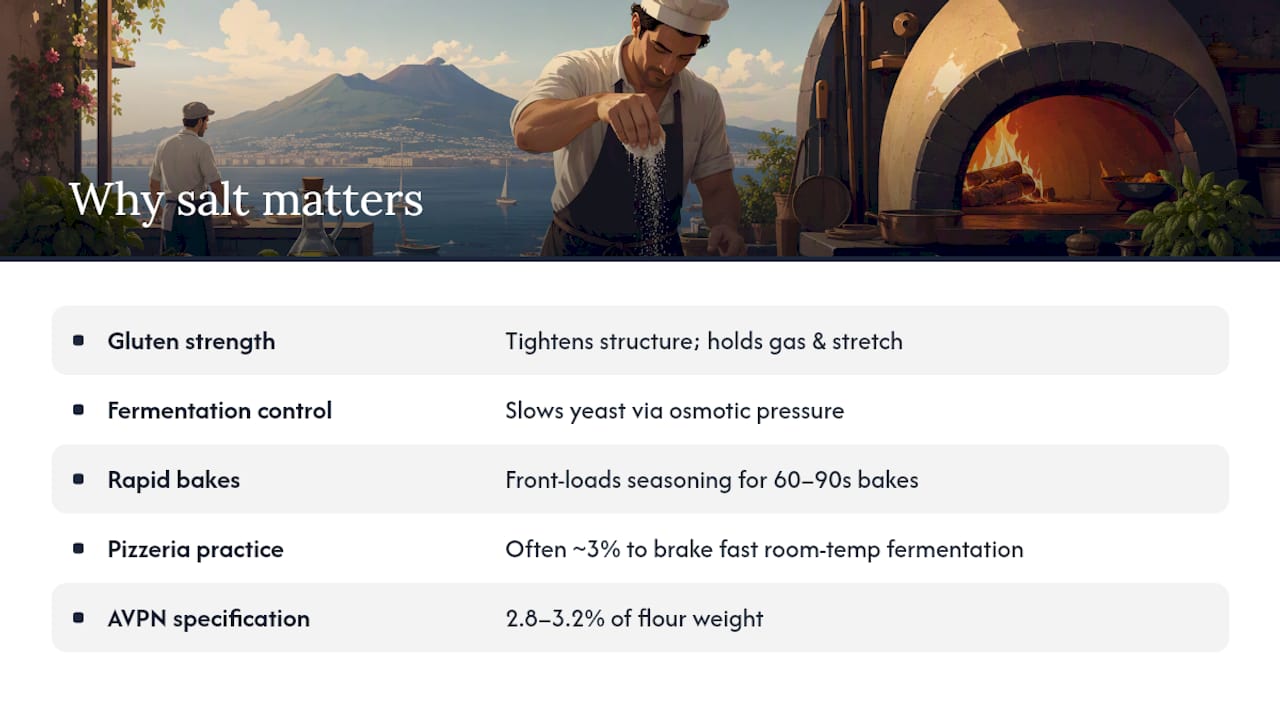
Salt does two jobs in dough that have nothing to do with taste. First, it tightens gluten structure, giving the dough more strength to hold gas and stretch without tearing during shaping. Second, it slows yeast activity through osmotic pressure, pulling water away from yeast cells and dialing back fermentation speed, according to food-science research on salt and dough behavior.
That second point explains why Neapolitan pizzerias lean toward the higher end of the range. A dough sitting out at room temperature for several hours ferments fast, and a pizzeria making hundreds of pies a night needs that fermentation to stay controlled through the whole shift. Pushing salt toward 3% acts as a brake, not a seasoning boost, an insight PizzaTechHQ makes clear when explaining why the traditional percentage sits higher than what home ovens strictly require.
There’s also a flavor delivery problem unique to Neapolitan pizza. A proper bake finishes in 60 to 90 seconds at extreme heat, which means the crust barely has time to develop deep flavor from caramelization the way a slower bake would. Higher salt compensates by front loading seasoning into the dough itself.
The AVPN specification, the official Neapolitan pizza standard, calls for a typical salt percentage for Neapolitan pizza dough, around 2.8 to 3.2% of flour weight. That’s not an arbitrary number. It’s the result of generations of pizzaiolos balancing fermentation control against a bake window measured in seconds.
How do you calculate baker’s percentage for salt?
The formula is straightforward:
- Find your flour weight. This is your baseline, always treated as 100%.
- Pick your target salt percentage. Choose somewhere in the 2.5–3.0% Neapolitan range based on your fermentation plan.
- Multiply flour weight by the percentage. For 500g flour at 2.8%, that’s 500 × 0.028 = 14g of salt.
- Repeat for water, yeast, and any other ingredient using the same flour baseline.
This method scales perfectly whether you’re making one pizza or ten, since every ingredient stays proportional to flour.
Measurement matters as much as the math. A digital scale accurate to at least 1 gram is worth the small expense, because teaspoon measures can be off by 40 to 50% depending on whether you’re using fine table salt or coarse sea salt, according to Pizzalator’s salt percentage guide. Coarse crystals take up more space per gram than fine crystals, so a “teaspoon” of salt is really a guess dressed up as a measurement.
Timing matters too. Salt should never touch yeast directly before they’re both incorporated into the flour. The traditional method, endorsed by AVPN’s own mixing instructions, dissolves salt into the water first, then adds flour, and only introduces yeast once some flour has already absorbed the salted water.
Pro Tip: Dissolve your salt completely in the water before adding flour. Undissolved crystals can create dense, salty pockets in the finished crust instead of even seasoning throughout.
Should you adjust salt for cold fermentation or room temperature?
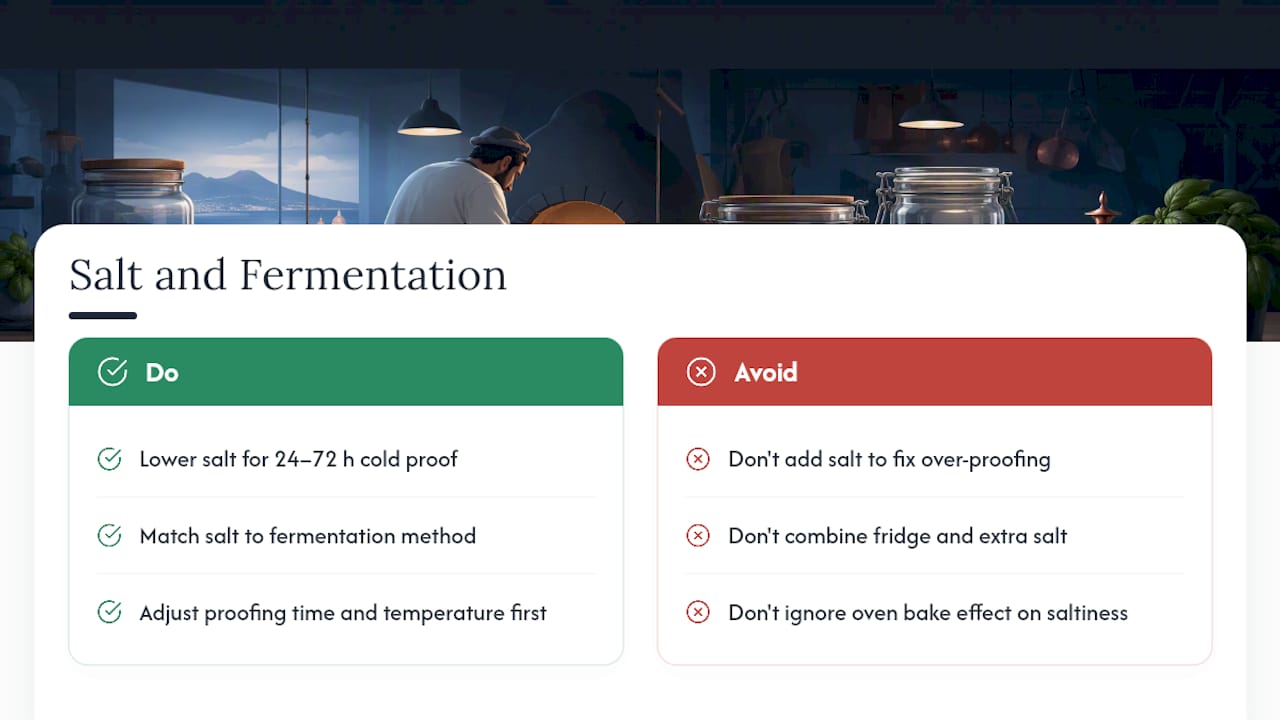
Yes, and the adjustment is bigger than most home cooks realize. Cold-fermented dough sitting in the refrigerator for 24 to 72 hours needs less salt than dough proofing on the counter, because refrigeration already slows yeast activity dramatically on its own.
The refrigerator does the fermentation-braking work that higher salt would otherwise handle, so you don’t need to stack both mechanisms. This lines up with guidance from Fond’s pizza dough ingredient breakdown, which notes that home bakers using refrigeration can hit the same flavor intensity with less salt precisely because cold proofing has already done most of the fermentation control.
Room temperature fermentation moves fast without the fridge’s brakes, so salt has to pick up the slack.
Oven type shifts perceived saltiness too. A screaming-hot wood-fired or high-end home oven finishes a pizza in under two minutes, concentrating flavor into a small window where every gram of salt reads clearly. A standard home oven running a longer 8 to 12 minute bake gives flavors more time to develop and mellow, which can make the same salt percentage taste slightly less sharp. If your dough is over-proofing and turning slack or sour, don’t reach for more salt as the fix. Adjust your proofing time or temperature first. Salt percentage should stay tied to your fermentation method, not become a patch for a timing problem.
What are the most common salt mistakes in pizza dough?
Most salt problems trace back to measurement, timing, or overcorrecting for an unrelated issue. Here’s what to watch for:
- Too salty dough: usually means volume measuring instead of weighing, or accidentally doubling a percentage when scaling a recipe up.
- Bland, flat-tasting crust: often means salt sat below 2%, or it never fully dissolved into the water before mixing.
- Salt touching yeast directly: kills or slows yeast unevenly, creating patchy fermentation and inconsistent rise across the dough ball.
- Hot kitchen, fast fermentation: the fix is cooler water or a shorter counter proof, not more salt. Salt percentage should track your fermentation method, not your kitchen’s thermostat.
If a batch does come out too salty, there’s no real fix for that dough, but pairing it with milder toppings and less salty cheese on the next bake can balance the plate while you dial in the percentage for future batches.
Two salt percentage formulas you can copy right now
Recipe A: Cold-ferment, 500g flour, 62% hydration, 2.5% salt
- Flour: 500g, Water: 310g (62%), Salt: 12.5g (2.5%), Yeast: 1g fresh yeast
- Dissolve salt fully in water, mix in flour until no dry patches remain, then add yeast
- Bulk ferment 2 hours at room temperature, then refrigerate 24 to 48 hours
- Pull dough out 2 hours before baking to come to room temperature before shaping
Recipe B: Room-temp Neapolitan, 1,000g flour, 62% hydration, 2.8% salt
- Flour: 1,000g, Water: 620g (62%), Salt: 28g (2.8%), Yeast: 2g fresh yeast
- Dissolve salt in water first, incorporate flour gradually, add yeast once some flour is absorbed
- Bulk ferment 8 to 10 hours at room temperature (around 68 to 72°F)
- Shape and bake immediately in a very hot oven, ideally 800°F or higher, for 60 to 90 seconds
Both formulas scale cleanly. Double every number to make more, or check Dough Dorks’ Neapolitan dough recipe for home ovens for shaping and bake timing adjusted to standard home oven temperatures.
Getting the salt percentage right without doing the math yourself
Some commercial dough suppliers bake every dough ball with a fixed, tested salt percentage inside a 48 hour cold fermentation, so the fermentation control and seasoning balance this article walks through are already locked in before the dough reaches your kitchen. That consistency comes from using Italian 00 flour, fresh yeast, and extra virgin olive oil in the same ratios every batch, rather than eyeballing percentages by hand. If you’d rather calculate your own formula, the dough calculator converts any target percentage into exact grams for your flour weight, removing the guesswork this article covers manually. And once your salt percentage is dialed in, seasoning choices on top, from cured meats to fresh mozzarella, deserve the same attention; the Neapolitan toppings guide breaks down how to balance perceived saltiness without touching your dough formula at all.
Skip the math with dough that’s already fermented right
Getting salt percentage right by hand means weighing precisely, timing your yeast contact, and tracking fermentation over hours or days, and one miscalculation throws the whole batch off. Doughdorks removes that risk entirely: every Pizza Dough Ball arrives already fermented for 48 hours with salt and yeast ratios calculated and tested, not guessed at with a teaspoon. If you want the room-temperature Neapolitan profile this article recommends without babysitting a fermentation schedule, buying pre-fermented dough can provide that consistency.
For cooks who want extra flavor complexity without adjusting a single gram of salt, the Italian herb dough balls carry seasoning baked into the dough itself. If you’re short on time but still want an authentic base, pre-cooked Neapolitan bases skip the fermentation step altogether while keeping the same salt balance. Whichever route fits your kitchen, pick your dough at Doughdorks and finish it with toppings from the pizza toppings collection for a full pizza night without touching a scale.
FAQ
Are pizzas high in salt?
Pizza can run high in sodium, but most of that comes from toppings like cured meats and aged cheese rather than the dough itself.
Which pizza has the lowest salt?
Skipping salty toppings like pepperoni or anchovies makes a bigger difference than adjusting the dough percentage alone.
How much salt is in 2 slices of pizza?
This varies enormously by topping choice, crust thickness, and slice size, so there’s no single fixed number.
How much salt is in pizza dough?
The AVPN specification sets the traditional band at roughly 2.8–3.2%, while home bakers using cold fermentation often use the lower end around 2.5%.
Recommended
- Neapolitan Pizza Dough: Authentic Recipe for Home Ovens
- Neapolitan Pizza Toppings: What’s Authentic (and What’s Not)
- The Only Neapolitan Pizza Sauce Recipe You Need
READY-MADE • FROZEN • UK DELIVERY
Skip the mixing. Keep proper dough in your freezer.
48-hour fermented, individually proofed in their own pot and delivered frozen across the UK. Defrost, stretch, top and bake.
-
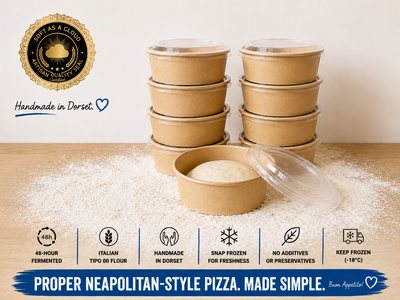
 48-Hour Neapolitan-Style Pizza Dough Balls – Box of 12
£22.88
-
 48-Hour Neapolitan-Style Pizza Dough Balls – Box of 20
£32.30
-
 48-Hour Neapolitan-Style Pizza Dough Balls – Box of 8
£18
Handmade in Dorset • Free UK delivery over £50 • Free proofing pot with every dough ball