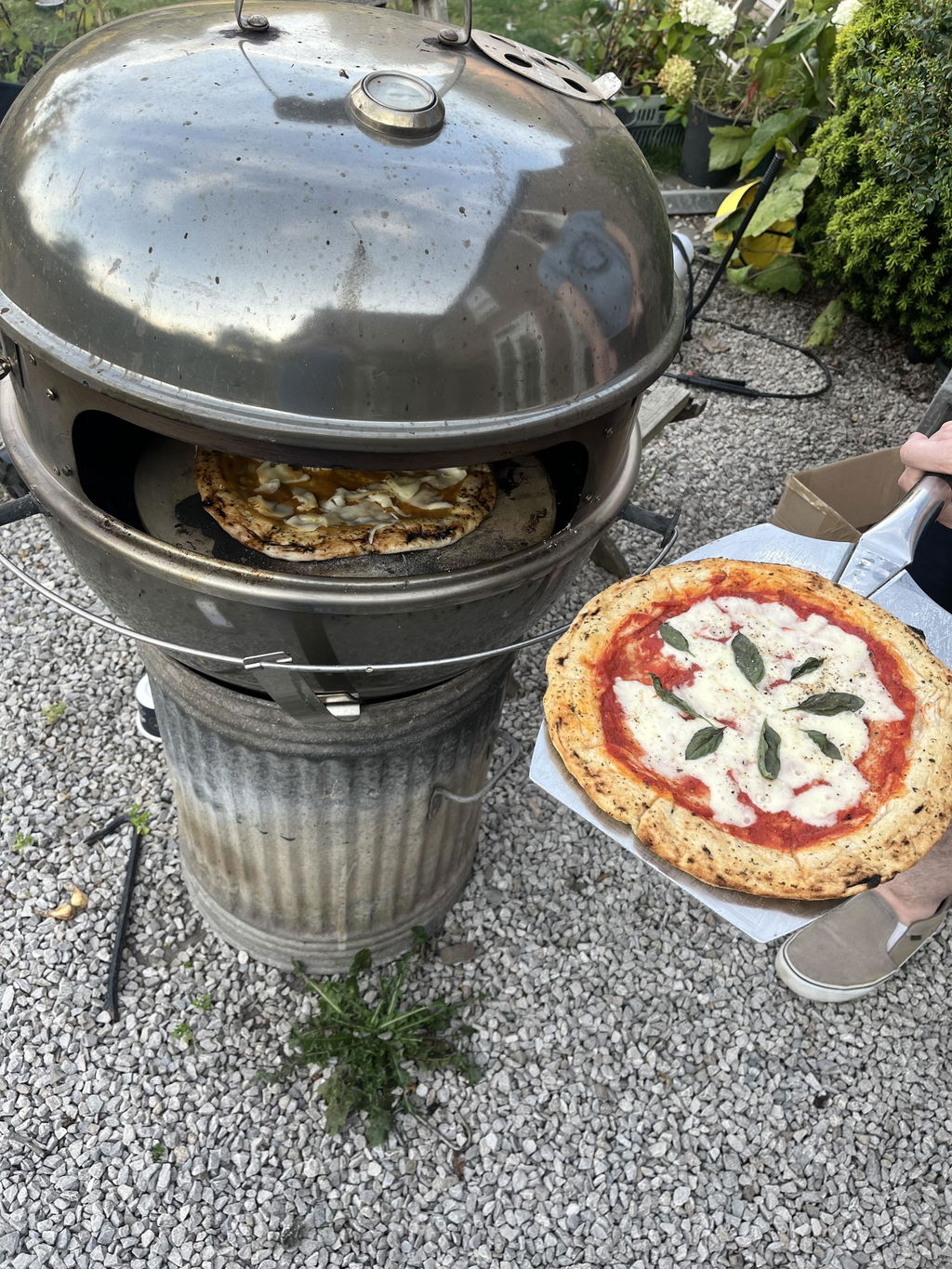
Best Pizza Peel UK: Top Picks for Home Cooks in 2026
Discover the best pizza peel UK for home cooks in 2026. Optimize your pizza-making with top picks and expert tips to elevate your skills!
For most UK home cooks, a perforated aluminum launching peel paired with a small round turning peel is the best setup you can buy. The perforated aluminum head keeps excess flour from burning on your stone, the thin edge slides cleanly under a cooked crust, and the two-peel system lets you rotate and retrieve without pulling the whole pizza out. Doughdorks recommends this approach for anyone cooking medium-sized Neapolitan-style pizzas at home.
Quick picks:
- Best for launching: Perforated aluminum peel (12–14 in head, long handle)
- Best for turning and retrieval: Small round metal turning peel (8–10 in head)
- Best budget start: A single wooden or bamboo peel for launches while you build confidence
Table of Contents
- What should you check before buying a pizza peel?
- Wood, aluminum, or stainless steel: which material wins?
- Does peel shape affect how well you can launch and turn?
- How long should a pizza peel handle be?
- How do you launch, turn, and retrieve a pizza without losing toppings?
- How do you clean and store a pizza peel?
- What do pizza peels cost in the UK, and where can you buy one?
- Why trust this guide?
- What’s the best pizza peel for your situation?
- Key Takeaways
- The peel is the part most home cooks underestimate
- Get started with Doughdorks: peel, dough, and everything you need
- Useful sources
What should you check before buying a pizza peel?
Before you spend anything, measure your oven. That single step eliminates half the bad buying decisions people make with peels.
Pre-purchase checklist:
- Oven mouth width: Your peel head should be 1–2 inches narrower than the oven opening so you can angle it in without scraping the sides.
- Oven interior depth: Handle length must let your hands stay well clear of the heat during a launch. For a standard UK domestic oven, a handle of 10–12 inches is usually enough; for an outdoor pizza oven, you may need 16 inches or more.
- Pizza size: Most home pizzas run 10–14 inches. Match the peel head to your typical pizza, not your maximum pizza.
- Primary task: Launching raw dough calls for a different peel than turning or retrieving a cooked one. Decide which job matters most before you look at materials.
- Perforation: Perforated heads reduce flour buildup on the stone and help crisp the base. If you bake on a pizza stone or steel, perforated is almost always the better call.
- Budget: Good peels start around £20 for a basic wooden option and climb to £70+ for premium perforated aluminum.
Pro Tip: Before buying online, check the listed head dimensions against your oven door opening with a tape measure. A peel that is even one inch too wide becomes frustrating to use every single time.
| Pizza size | Recommended peel head | Oven type |
|---|---|---|
| 10 in | 10 in | Compact domestic or countertop oven |
| 12 in | 12 in | Standard UK domestic oven |
| 14 in | 13–14 in | Large domestic oven or outdoor pizza oven |
| 16 in | 14 in | Outdoor pizza oven (Ooni, Gozney, etc.) |
Wood, aluminum, or stainless steel: which material wins?
The material you pick should follow the task, not the aesthetics. Each has a clear job.
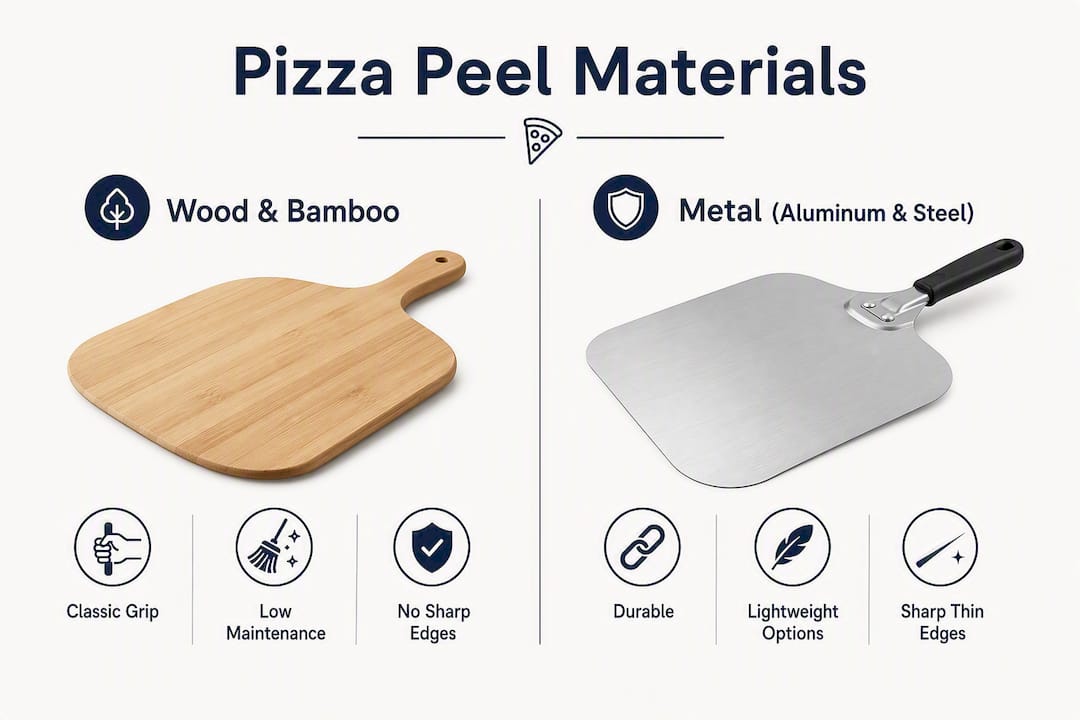
Wood and bamboo
Wooden peels are the classic launching tool. The slightly porous surface grips flour and semolina well, which means raw dough slides around less while you’re building the pizza and then releases cleanly with a quick shake. The trade-off is thickness: wood heads tend to run 6–10mm, which makes sliding under a fully cooked pizza harder than with metal. They also need hand-washing and occasional oiling to prevent cracking. Practical testing consistently shows wood and bamboo as the preferred launching surface precisely because raw dough sticks less than it does on bare metal.
Aluminum
Aluminum is the workhorse of the two-peel system. It’s light, it machines to a thin edge, and it slides under a cooked crust without disturbing the toppings. Tested picks from Business Insider highlight that thin metal edge as the key retrieval advantage. Perforated aluminum goes one step further: the holes let excess flour and semolina fall away before the pizza hits the stone, which protects flavor and promotes a crisper base. Ooni’s perforated peel design specifically promotes flour separation and airflow under the pizza for exactly this reason.
Stainless steel
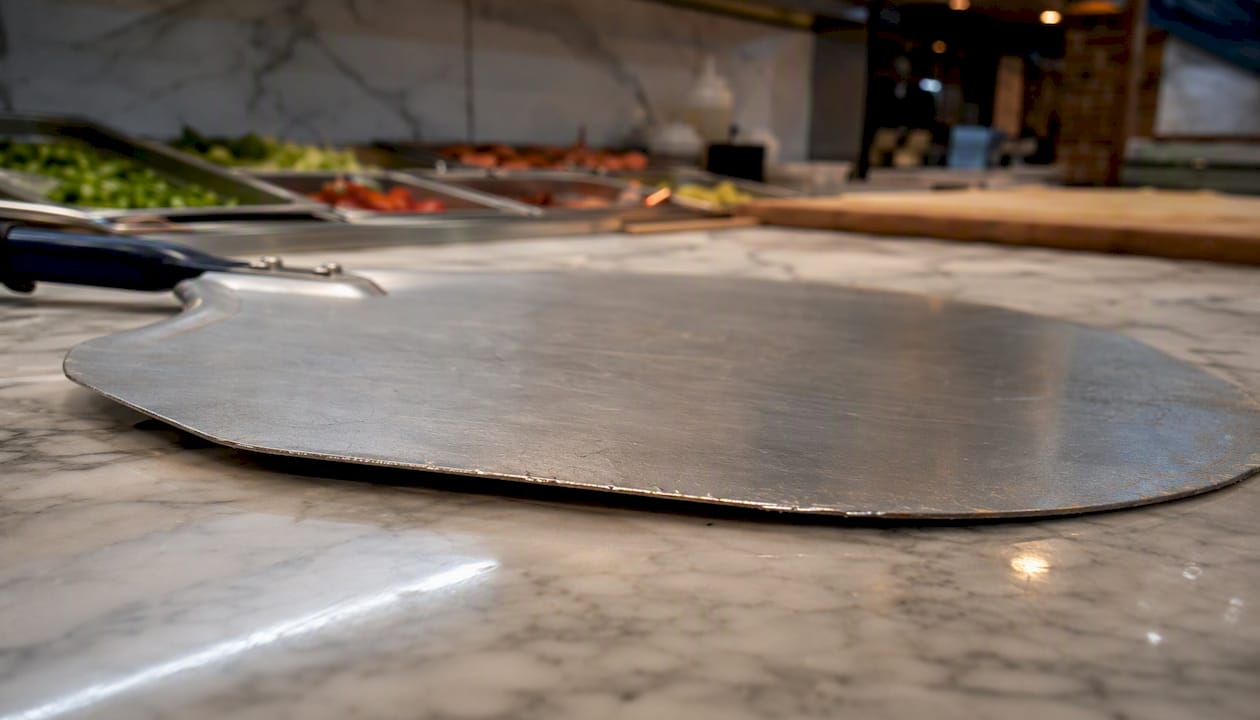
Stainless steel is more durable than aluminum and holds its shape under heavy use, but it’s also heavier. For home use, that extra weight rarely pays off. It’s the right call if you’re baking multiple pizzas back-to-back and want something that won’t flex, but most home cooks find aluminum easier to handle.
| Material | Best for | Maintenance | Typical edge | Perforated option | Price range (UK) |
|---|---|---|---|---|---|
| Wood/bamboo | Launching raw dough | Hand wash, oil monthly | Thick edge | Rarely | £20–£35 |
| Aluminum | Retrieval, turning, launching | Hand wash or wipe | Thin edge | Common | £30–£70 |
| Stainless steel | High-volume, durability | Hand wash | Thin edge | Less common | £30–£70 |
Pro Tip: Dust your peel with semolina rather than plain flour before building the pizza. Semolina’s coarser grain acts like tiny ball bearings and makes the launch far more reliable. If you’re nervous about a new peel, build the pizza on a sheet of parchment and slide the whole thing in — then pull the parchment out after 60 seconds once the base has set.
Does peel shape affect how well you can launch and turn?
Shape is the most overlooked spec in a pizza peel buying guide, and it directly changes what the peel can do.
Round heads are turning peels. A small round head (8–10 inches) fits under one side of a pizza mid-cook and lets you rotate it without lifting the whole thing. You can’t build a pizza on a round peel easily, but that’s not what it’s for.
Rectangular and square heads are launching peels. The flat corners give you a full working surface to build the pizza, and the straight edge slides under the dough cleanly. Most home cooks start with a rectangular head and add a round turning peel later.
Ooni’s guidance recommends matching peel size to oven size and choosing a head slightly smaller than your oven mouth to allow maneuvering room. For a 12-inch pizza in a standard UK domestic oven, a 12-inch rectangular head is the practical sweet spot.
Pro Tip: If you only buy one peel, go rectangular. You can rotate a pizza with a rectangular peel by nudging it in short arcs. It’s less elegant than a turning peel, but it works until you’re ready to add one.
| Oven opening | Pizza size | Peel head shape | Recommended head size |
|---|---|---|---|
| Up to 13 in | 10–12 in | Rectangular | 12 in |
| 13–16 in | 12–14 in | Rectangular | 13–14 in |
| Any | Any | Round (turning) | 8–10 in |
How long should a pizza peel handle be?
Handle length is a safety spec as much as a comfort one. The handle keeps your hands away from a 400–500°C oven surface, and getting that distance wrong means burns.
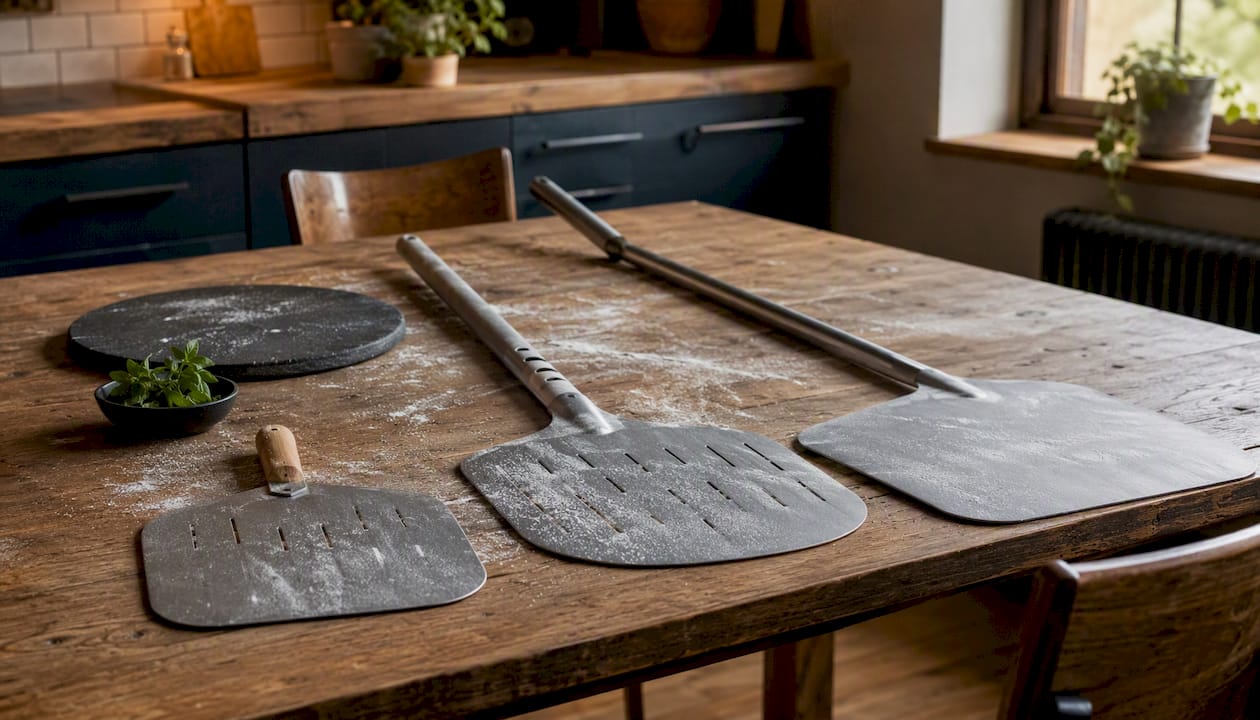
For a standard UK domestic oven, a handle of typical moderate length gives enough reach without making the peel unwieldy in a small kitchen. Outdoor pizza ovens with deeper chambers need longer handles to ensure hand safety. The rule: measure from your oven door to the back of the baking surface, then add clearance for your hands.
Ergonomics checklist:
- Does the handle feel balanced when the head is loaded with a 300g dough ball?
- Can you grip it with one hand and shake the peel gently without strain?
- Is the handle round (easier to rotate) or flat (more stable for straight launches)?
- Does the handle material stay cool? Wood and plastic stay cooler than bare metal.
Aluminum peels tend to be lighter overall, which reduces wrist fatigue during repeated launches. Wooden peels with large heads can feel front-heavy. If you’re buying online and can’t test the balance, look for a listed weight under 600g for a 12-inch aluminum peel.
Pro Tip: A peel that’s too long for your kitchen is as frustrating as one that’s too short for your oven. Measure the space between your oven and the nearest counter edge before committing to a long-handled model.
How do you launch, turn, and retrieve a pizza without losing toppings?
The launch is where most home cooks lose confidence. The good news: it’s a technique problem, not a peel problem, and it gets reliable fast with a few deliberate steps.
- Dust the peel generously with semolina or a semolina-flour mix before placing the dough. Lift the dough edge and check it moves freely before adding toppings.
- Build quickly. The longer raw dough sits on the peel, the more moisture transfers and the more it sticks. Aim to top and launch within 60–90 seconds.
- Position the peel at the oven mouth at a shallow angle, with the tip just touching the back of the stone or steel.
- Use a short, sharp forward-and-back motion to slide the pizza off. Don’t tilt the peel down steeply — keep it nearly flat and let the dough’s momentum do the work.
- Rotate mid-cook using a small round turning peel. Slide it under one edge and spin the pizza 90° every 30–45 seconds for even cooking. Serious Eats’ 2026 round-up of 13 tested peels specifically recommends using different peels by task, with metal for turning and retrieval.
- Check the base by lifting one edge with the peel tip. When it’s golden and firm, slide the peel fully under and pull straight back.
Pro Tip: Practice the launch motion with a paper plate or a pre-cooked pizza base before you try it with raw dough. The muscle memory transfers directly and you won’t waste a dough ball learning the angle.
How do you clean and store a pizza peel?
A peel that warps or cracks is a peel you’ll replace within a year. The maintenance rules are simple and take two minutes.
After each use:
- Wooden peels: Wipe clean with a damp cloth immediately after use. Never soak or put in a dishwasher. Once a month, rub a thin coat of food-safe mineral oil into the wood and let it absorb overnight.
- Aluminum peels: Wipe with a damp cloth or wash by hand with mild soap. Most aluminum peels are not dishwasher-safe — the heat and detergent can oxidize the surface over time.
- Stainless steel peels: Hand wash is safest; check the manufacturer’s guidance before putting any metal peel in a dishwasher.
Storage:
- Store wooden peels flat or hang them by the handle hole. Leaning them against a wall at an angle causes warping over weeks.
- Keep peels away from direct heat sources when not in use.
- Check the handle joint every few months. A loose handle on a loaded peel is a real hazard.
Longer-term wooden peel care:
- Sand lightly with fine-grit sandpaper if the surface feels rough or develops splinters.
- Re-oil after sanding.
- Check the edge bevel — if it’s thickened from use, a few passes with sandpaper restore the thin leading edge.
What do pizza peels cost in the UK, and where can you buy one?
UK prices break into three clear bands, and the jump from budget to mid-range is worth making if you bake more than occasionally.
| Band | Typical UK price | What you get |
|---|---|---|
| Budget | £20–£30 | Basic wood or thin aluminum, fixed handle, no perforation |
| Mid-range | £30–£60 | Perforated aluminum, better edge bevel, longer handle options |
| Premium | £60–£70 | Branded perforated peels such as Ooni (£60) and Gozney (£69.99), replaceable handles, precision engineering |
BBC Good Food’s May 2025 review placed the Ooni Perforated Pizza Peel at around £60 and the Gozney Balance Turning Peel at around £69.99, both sitting at the top of the mid-range band. Availability across UK retailers varies: Waitrose, Lakeland, and direct brand stores all stock peels, but ranges shift seasonally.
Buying tips for UK shoppers:
- Buy direct from brand websites (Ooni UK, Gozney) for the widest size selection and reliable stock.
- Check return policies before buying online. A peel that feels wrong in the hand is hard to judge from a product page.
- Most UK retailers offer 30-day returns on unused kitchen equipment under standard consumer rights.
- Doughdorks stocks pizza accessories alongside its dough and ingredient range, making it a practical one-stop option for UK home cooks who want to buy a peel alongside their first dough order.
Why trust this guide?
Doughdorks has tested and recommended pizza-making equipment for UK home cooks as part of its focus on authentic Neapolitan-style pizza at home. The picks in this guide reflect hands-on evaluation of peel performance across launching, turning, and retrieval tasks using Neapolitan dough at high temperatures.
[Insert Michael’s pizza-making experience and credentials]
[Insert testimonials or customer reviews demonstrating trust]
[Insert case studies or examples of expertise in authentic Neapolitan pizza]
The two-peel recommendation in this guide aligns with findings from Serious Eats across 13 tested peels: no single peel does every job best. A wooden or bamboo peel for launching and a metal turning peel for rotation and retrieval is the setup that consistently produces the best results at home.
- Perforated aluminum outperforms solid metal for launching because excess flour falls away before hitting the stone.
- Wood outperforms metal for raw dough launches because it grips semolina better and reduces sticking.
- A two-peel system costs less than £130 total (Ooni Perforated Pizza Peel around £60 and Gozney Balance Turning Peel around £69.99 as of May 2025) and lasts years with basic care.
What’s the best pizza peel for your situation?
A perforated aluminum launching peel is the single best all-round pick for most UK home cooks. It handles launching and retrieval well, cleans easily, and pairs with a turning peel when you’re ready to upgrade.
By use-case:
- Best all-round: Perforated aluminum rectangular peel, 12–14 in head, 10–14 in handle.
- Best for turning: Small round metal turning peel, 8–10 in head.
- Best budget start: Wooden or bamboo peel, 12 in head. Simple, effective for launches, and forgiving while you learn.
- Best starter kit: Perforated aluminum launching peel plus a box of ready-made Neapolitan dough balls for immediate practice.
If you’re buying one peel, buy the perforated aluminum. If you’re buying two, add a round turning peel and you’ll have a setup that matches what professional kitchens use.
Key Takeaways
A perforated aluminum launching peel paired with a small round turning peel gives UK home cooks the most reliable results across launching, rotating, and retrieving Neapolitan-style pizza.
| Point | Details |
|---|---|
| Measure before you buy | Peel head should be 1–2 inches narrower than your oven mouth; handle must clear the heat. |
| Match material to task | Wood/bamboo for launching raw dough; aluminum for retrieval and turning. |
| Perforated beats solid | Perforated heads let excess flour fall away, protecting flavor and crisping the base. |
| Two-peel system wins | A launching peel plus a small round turning peel covers every task for under £100. |
| Doughdorks starter kit | Pair a perforated aluminum peel with Doughdorks’ ready-made dough balls for immediate practice. |
The peel is the part most home cooks underestimate
Most people buying their first pizza setup spend time choosing the oven and almost no time choosing the peel. That’s backwards. The oven heats the pizza; the peel determines whether it gets there in one piece.
The two-peel approach feels like overkill until the first time you try to rotate a pizza mid-cook with a long rectangular launching peel and watch half the toppings slide off. A small round turning peel solves that problem completely. For UK kitchens where oven space is tight and the margin for error is small, having the right tool for each job matters more than having one versatile tool that does everything adequately.
The other thing worth saying: technique matters as much as equipment. A wooden peel with good semolina technique will outperform an expensive perforated peel used without preparation. Buy the right peel, learn the launch motion, and the results follow.
Get started with Doughdorks: peel, dough, and everything you need
The fastest way to go from buying a peel to making great pizza at home is pairing it with dough that’s already been properly fermented. Doughdorks ships 48-hour Neapolitan dough balls made with Italian 00 flour, fresh yeast, and extra virgin olive oil directly to your door across the UK. You get dough that’s ready to stretch, top, and launch the same day it arrives.

If you want to practice your launch technique before committing to raw dough, Doughdorks’ pre-cooked Neapolitan bases are the low-stakes way to get the peel motion right. They behave like a real pizza on the peel without the risk of a stuck launch ruining a carefully built Neapolitan. Order your dough or bases alongside your peel and you’ll be cooking the same evening they arrive.
Useful sources
The following sources informed the recommendations and technical claims in this guide:
- BBC Good Food — Best pizza oven accessories 2025: UK-focused reviews with tested price points for the Ooni and Gozney peels.
- Serious Eats — The 7 best pizza peels of 2026: Hands-on testing of 13 peels with task-specific recommendations.
- Pizza Prep Table — Complete guide to choosing the best pizza peel: Practical launch and maintenance guidance, including semolina technique.
- Business Insider — Best pizza peels, tested and reviewed: Edge thickness data and retrieval performance comparisons.
Recommended
- Freshly Made Pizza Dough Balls Delivered | Best Pizza Dough Online
- 10 Home Pizza Oven Accessories That Matter - Dough Dorks
- Best Pizza Dough Balls for Home Cooks (2026 Guide)
- Ready Made Pizza Bases Guide for Better Pizza - Dough Dorks
READY-MADE • FROZEN • UK DELIVERY
Skip the mixing. Keep proper dough in your freezer.
48-hour fermented, individually proofed in their own pot and delivered frozen across the UK. Defrost, stretch, top and bake.
-
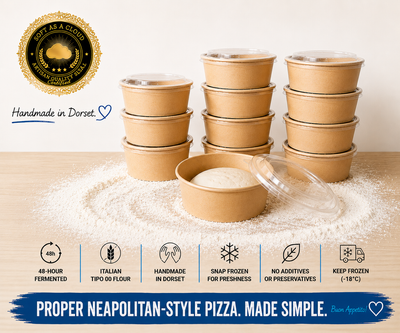 48-Hour Neapolitan-Style Pizza Dough Balls – Box of 12
£22.88
48-Hour Neapolitan-Style Pizza Dough Balls – Box of 12
£22.88
-
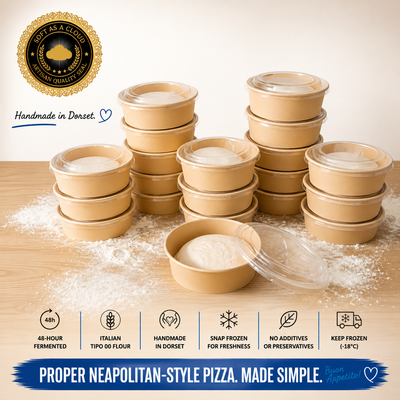 48-Hour Neapolitan-Style Pizza Dough Balls – Box of 20
£32.30
48-Hour Neapolitan-Style Pizza Dough Balls – Box of 20
£32.30
-
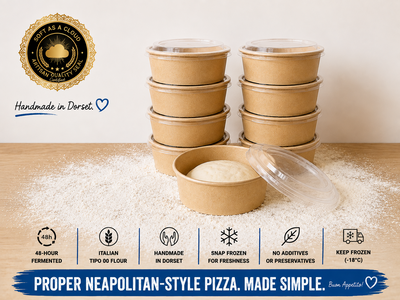 48-Hour Neapolitan-Style Pizza Dough Balls – Box of 8
£18
48-Hour Neapolitan-Style Pizza Dough Balls – Box of 8
£18
Handmade in Dorset • Free UK delivery over £50 • Free proofing pot with every dough ball