Why Does Pizza Dough Keep Shrinking Back? How to Fix It
Quick answer
If pizza dough keeps shrinking back when you stretch it, the gluten is usually too tight, too cold or has not had enough time to relax.
The simplest fix is to stop stretching, cover the dough and leave it alone for another 10–15 minutes. When you return to it, the dough should be more relaxed and easier to open.
Why does pizza dough shrink back?
Pizza dough contains gluten, the elastic protein network that gives the dough strength. That elasticity is essential because it traps the gas produced during fermentation, but if the gluten is too tense it behaves like a stretched elastic band and pulls the dough back towards its original shape.
This is especially common when the dough is cold or has just been handled heavily.
The most common reasons pizza dough keeps springing back
1. The dough is too cold
Cold dough is firmer and less extensible. If you are using frozen or refrigerated dough, make sure the centre has warmed sufficiently before trying to stretch it.
For Dough Dorks dough balls, around 18–20°C is a useful handling temperature.
2. The dough needs to rest
Every time you stretch, knead or reshape dough, the gluten can tighten again. Resting gives that gluten network time to relax.
If the dough is resisting, a short covered rest is often more effective than using more force.
3. The dough is under-proofed
Under-proofed dough may feel dense and tight because it has not had enough fermentation and relaxation time. It can be difficult to open and may bake heavier than properly proofed dough.
Read our pizza dough proofing guide for the signs to look for.
4. You are stretching too aggressively
Trying to force a dough ball straight to full size can make the gluten fight back. Open it gradually and rotate it as you stretch.
5. The dough has been re-balled recently
Shaping dough into a tight ball creates surface tension. If you re-ball dough immediately before making pizza, it may need time to relax again before it will stretch comfortably.
How to stop pizza dough shrinking back
- Check the temperature. Make sure the dough is fully thawed and not cold in the centre.
- Cover it. This stops the surface drying out while it rests.
- Wait 10–15 minutes. Let the gluten relax naturally.
- Start gently. Press from the centre out rather than pulling hard at the edges.
- Rotate frequently. Stretch the pizza evenly instead of repeatedly working one area.
Should you keep adding flour?
No. Flour helps prevent sticking but it does not fix tight gluten. If the dough is springing back, adding more flour will not make it relax.
Use a light dusting for handling, then give the dough the time it actually needs.
Should you use a rolling pin?
A rolling pin can physically force dough flatter, but for Neapolitan-style pizza it also pushes gas out of the dough, particularly from the outer rim. That can produce a flatter, denser crust.
For an airy cornicione, hand stretching is the better approach.
Why does frozen pizza dough shrink back?
The most common reason is that it has thawed on the outside but is still too cold through the middle. Do not judge frozen dough by the surface alone.
Keep the dough covered until it is soft all the way through, then give it time to relax before stretching.
See our guide to defrosting frozen pizza dough balls.
How do you know when the dough is relaxed enough?
Press it gently with your fingertips. Ready dough should yield easily and should not immediately spring all the way back. When you begin opening it, the dough should widen progressively rather than constantly contracting.
What if it still will not stretch after resting?
Give it another short rest and check that the dough is not still cold. A cooler kitchen may simply mean the process takes longer.
If homemade dough consistently stays extremely tight even when warm, the recipe, flour, hydration, kneading or fermentation method may also be contributing.
How large should the dough stretch?
A standard Dough Dorks dough ball is around 265g and is designed for roughly one generous 12-inch Neapolitan-style pizza.
If you are trying to force that amount of dough far beyond its intended diameter, it becomes much easier to create thin spots and tears. See our 12-inch pizza dough weight guide.
The easy rule to remember
If the dough fights you, do not fight the dough. Cover it, give it time and come back to it.
For the full stretching method, read how to stretch pizza dough without tearing.
Ready-made dough that has already had the long ferment
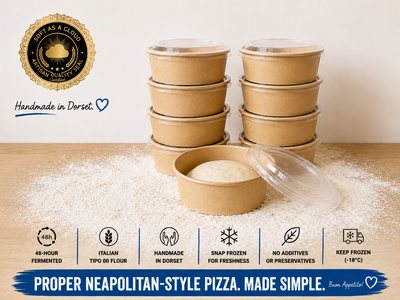
Dough Dorks dough is slowly fermented for 48 hours, portioned into individual balls and frozen for convenience. Browse our pizza dough balls for UK delivery.
READY-MADE • FROZEN • UK DELIVERY
Skip the mixing. Keep proper dough in your freezer.
48-hour fermented, individually proofed in their own pot and delivered frozen across the UK. Defrost, stretch, top and bake.
-
 48-Hour Neapolitan Pizza Dough Balls – Box of 12
£26
-
 48-Hour Neapolitan Pizza Dough Balls – Box of 20
£38
-
 48-Hour Neapolitan Pizza Dough Balls – Box of 8
£20
Handmade in Dorset • Free UK delivery over £50 • Free proofing pot with every dough ball